In this post of Nelson Mandela Summary, you will find every detail that has been written in NCERT book of this chapter. Along with the summary, you will also find important Key Points, Word Meanings, and Theme of the chapter.
📄Nelson Mandela Chapter Overview Table
| Chapter Name | Nelson Mandela: Long Walk To Freedom |
| Book | Chapter 2 First Flight (Class 10 English) |
| Author | Nelson Rolihlahla Mandela |
| Theme | Freedom and Equality |
Table of Contents
Nelson Mandela Theme
The main theme of this chapter is the concept of freedom and the impact of its absence or presence. It compares different forms of bondage and oppression with the aspiration and eventual attainment of true freedom and dignity. Whether it is the political slavery of apartheid or the physical captivity of a zoo animal, this chapter emphasises the fundamental right to freedom and the unwavering spirit that strives for it.
✅ Important Key Points for Answer Writing
Along with the theme, we have written some important Key Points that must be remembered by the students. These keypoints are designed in a way that students can use it in their answers.
The End of Apartheid and Mandela’s Presidency:
This chapter highlights the historic moment when Nelson Mandela became the first black president of South Africa on May 10, 1994, after more than three centuries of white rule and thirty years in prison. This marked the end of the “apartheid” system that racially segregated people.
Inaugural Ceremony:
The event took place at Pretoria’s Union Buildings Amphitheatre, historically a “seat of white supremacy” but transformed into a “rainbow gathering of different colours and nations” to establish South Africa’s first democratic, non-racial government. It was the largest gathering of international leaders ever on South African soil, with dignitaries from more than 140 countries attending.
Mandela’s Inaugural Address:
He spoke of a “newborn freedom” emerging from “an extraordinary human disaster that had lasted too long.”
He pledged that “Never, never again will this beautiful land experience the oppression of one by another”.
He thanked the international guests for the “shared triumph of justice, peace and human dignity”.
He pledged to liberate all South Africans from poverty, deprivation, suffering, gender discrimination and other forms of discrimination.
Symbolism of the day:
A spectacular display of military loyalty to the new democratic government, involving jets, helicopters and troop carriers, contrasted with the fact that a few years earlier, these same generals would have arrested Mandela.
The singing of the two national anthems, ‘Nkosi Sikelel-iAfrika’ (the black national anthem) and ‘Die Stem’ (the old white national anthem), symbolised an attitude of unity, although their lyrics were not yet memorised by everyone.
Reflection on history and oppression:
Mandela felt “overwhelmed with the spirit of history”, reflecting on the rigid system of racial domination established in the early 20th century, which was now “overturned forever”. He believed that his achievement was the “sum of all the African patriots” who had sacrificed before him.
📄 Nelson Mandela Summary
Chapter introduces us to the end of apartheid in South Africa, a political system that separated people on the basis of race. After spending thirty years in prison fighting against this system, Nelson Mandela and his African National Congress (ANC) party achieved an unprecedented victory.
On May 10, 1994, a historic day dawned bright and clear. Mandela became the first black president of South Africa, ending more than three centuries of white rule. The inauguration ceremony was held at the Union Buildings Amphitheatre in Pretoria, formerly the “seat of white supremacy”. However, this time the largest gathering of international leaders ever on South African soil took place, with politicians and dignitaries from more than 140 countries attending. It was truly “a rainbow gathering of different colours and nations” to establish the country’s first democratic, non-racial government.
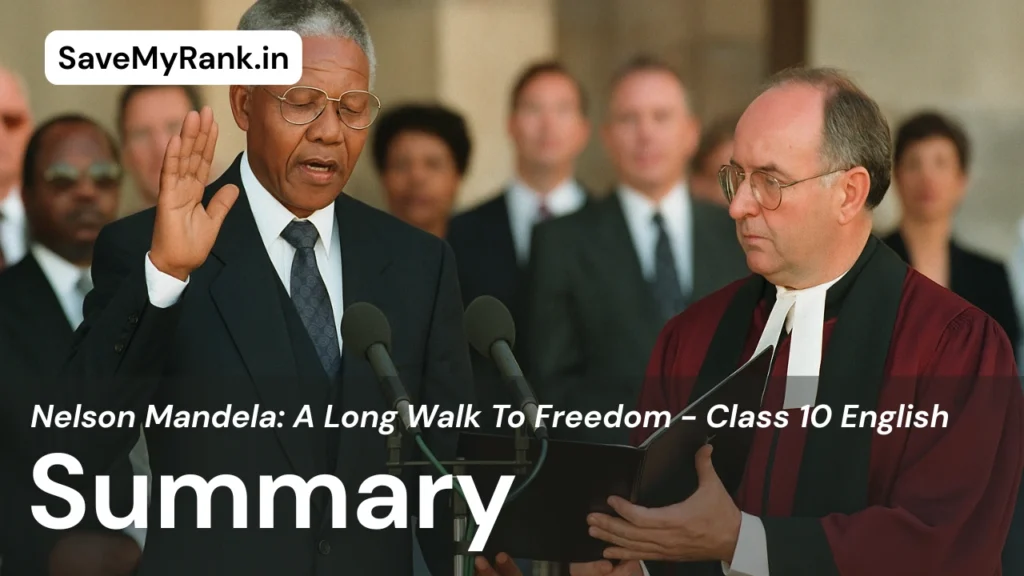
During the ceremony, Mandela, accompanied by his daughter Zenani, watched Mr de Klerk being sworn in as Second Deputy President and Thabo Mbeki as First Deputy President. When his turn came, Mandela pledged to abide by and uphold the Constitution and to devote himself to the well-being of the Republic and its people.
Addressing the assembled guests and the world, Mandela spoke of the “nascent freedom” that emerged from “an extraordinary human disaster that lasted too long” – a reference to apartheid. He declared that “this beautiful land will never, ever again experience oppression of one another”. He thanked the international community for joining him in what he called a “shared victory for justice, peace and human dignity”. He also pledged to free all South Africans from poverty, deprivation, suffering, gender discrimination and other forms of discrimination. He concluded his powerful speech with the hope that “the sun will never set on such a magnificent human achievement. May freedom reign. God bless Africa!”.
Inauguration Day also saw a spectacular display of South African jets, helicopters and troop carriers flying over the Union Buildings. This was not just a display of military power, but also of the army’s loyalty to the new democratic government. Mandela understood its significance and recognised that a few years earlier, the same generals who were now saluting him would have arrested him. The Impala jets left a trail of smoke in the colours of the new South African flag (black, red, green, blue and gold).
A highly symbolic moment was the singing of the two national anthems: ‘Nkosi Sikelel-iAfrika‘ (the black national anthem) and ‘Die Stem‘ (the old white national anthem). Although none of the groups knew the songs by heart that day, it still represented a philosophy of unity.
Mandela reflected on being “overwhelmed with the spirit of history”. He recalled how, in the early 20th century, a system of racial domination was established against black people, creating “one of the most inhumane and harshest societies the world has ever seen.” Now, in the late 20th century, that system had been “overturned forever.” He felt that they were “a group of African patriots” whose unimaginable sacrifice and courage made this moment possible.
He also shared deep insights about the unintended effects of oppression: while apartheid left a “deep and lasting wound,” it also produced leaders of “extraordinary courage, wisdom and generosity” such as Oliver Tambo, Walter Sisulu and others. Mandela learned that courage was not the absence of fear, but the triumph over it. He believed that love came more naturally to the human heart than hate, and insisted that if people could learn to hate, they could certainly be taught to love. Even during the darkest times in prison, “a glimpse of humanity” from the guards was enough to keep him going.
Mandela discussed the concept of “double obligations” in life: to his family and to his people/country. In apartheid South Africa, it was nearly impossible for a black man to fulfill both, as serving his people meant “being separated from his family and his home”.
Finally, he elaborated on how his understanding of freedom evolved. As a child, he felt free to move around and live according to tribal customs. As a student, he sought “momentary freedoms” such as staying out late. Later, as a young man, he longed for “basic and dignified freedoms” such as earning a living and raising a family. However, he soon realized that his freedom, and the freedom of all people who looked like him, was limited. This led him to join the African National Congress, and his personal hunger for freedom became “a greater hunger for the freedom of his people”. He concluded that “freedom is indivisible” – if one person is in chains, all are. He also stated emphatically that the oppressor must be freed just as much as the oppressed, because those who take away freedom are “prisoners of hatred”.
📗Nelson Mandela Chapter Word Meanings
This is the list of difficult words and their meanings in the chapter “Nelson Mandela: A Long Walk To Freedom”. These words are taken from NCERT book
| Word | Meaning |
|---|---|
| PAGE 16 | |
| apartheid | racial segregation or racial discrimination |
| autobiography | life story (biography) of a person written by that person himself or herself |
| amphitheatre | large open theatre |
| dignitaries | eminent persons |
| oppression | harsh and unfair treatment |
| jubilant | joyful, happy |
| PAGE 17 | |
| dawned | began |
| besieged | surrounded by |
| decades | periods of ten years |
| supremacy | being superior |
| installation | placement |
| sworn | took an oath |
| PAGE 18 | |
| confer | to give |
| outlaws | deprived of the benefit and protection of the law |
| rare privilege | uncommon right |
| possession | control |
| emancipation | freedom from restriction; liberation |
| bondage | slavery |
| discrimination | state of being treated differently |
| reign | rule |
| PAGE 19 | |
| awe | respect and fear |
| spectacular array | attractive display |
| troop carriers | vehicles carrying soldiers |
| PAGE 20 | |
| pinpoint precision | complete/perfect order |
| beckoned | declared |
| not unmindful | aware |
| chevron | a figure or pattern having the shape of a “V” |
| trail | line |
| symbolised | used like a symbol, represented |
| despised | hated |
| overwhelmed | have a strong emotional effect |
| patched up | settled |
| erected | built |
| racial domination | control due to race |
| inhumane | cruel |
| overturned | abolished, invalidated and reversed |
| wrought | done, worked into shape by efforts |
| profound | deep and strong |
| brutality | cruelty |
| unintended | not thought of |
| PAGE 21 | |
| comrades | fellow patriots |
| resilience | ability to deal with any hardship |
| defies | challenges |
| conquer | gets victory |
| grimmest | saddest, worst |
| pushed to our limits | pressurised |
| glimmer | glimpse, a dim perception |
| humanity | sympathy and kindness |
| PAGE 22 | |
| extinguished | put out |
| obligations | duties |
| inclinations | natural tendencies, leanings |
| isolated | separated from others |
| inevitably | unavoidably |
| gripped | taken away |
| twilight existence | not being allowed to live freely |
| roast mealies | bake maize corns |
| abided | obeyed |
| illusion | a false idea or belief |
| transitory | not permanent |
| yearned | desired deeply |
| obstructed | hindered |
| curtailed | limited |
| PAGE 23 | |
| dignity | respect |
| animated | gave life to |
| law-abiding | who obeys rules |
| virtuous | having high moral standards |
| oppressor | a cruel person who prevents other people from having any rights or freedom |
| oppressed | a person who is subject to harsh and authoritarian treatment |
| bars | obstacles |
| prejudice | hatred, bias |
| narrow-mindedness | state of having intolerant beliefs |
Frequently Asked Questions from Nelson Mandela Summary
Q1. What is the main theme of the chapter “Nelson Mandela: Long Walk to Freedom”?
The chapter highlights themes of freedom, courage, and sacrifice, focusing on Mandela’s struggle against racial oppression in South Africa.
Q2. What is apartheid, as mentioned in the chapter?
Apartheid was a system of legal racial segregation in South Africa where non-white citizens were denied basic rights, freedom, and equality.
Q3. Who was Nelson Mandela?
Nelson Mandela was a South African anti-apartheid revolutionary who became the first Black President of South Africa in 1994. He fought for freedom, equality, and justice.